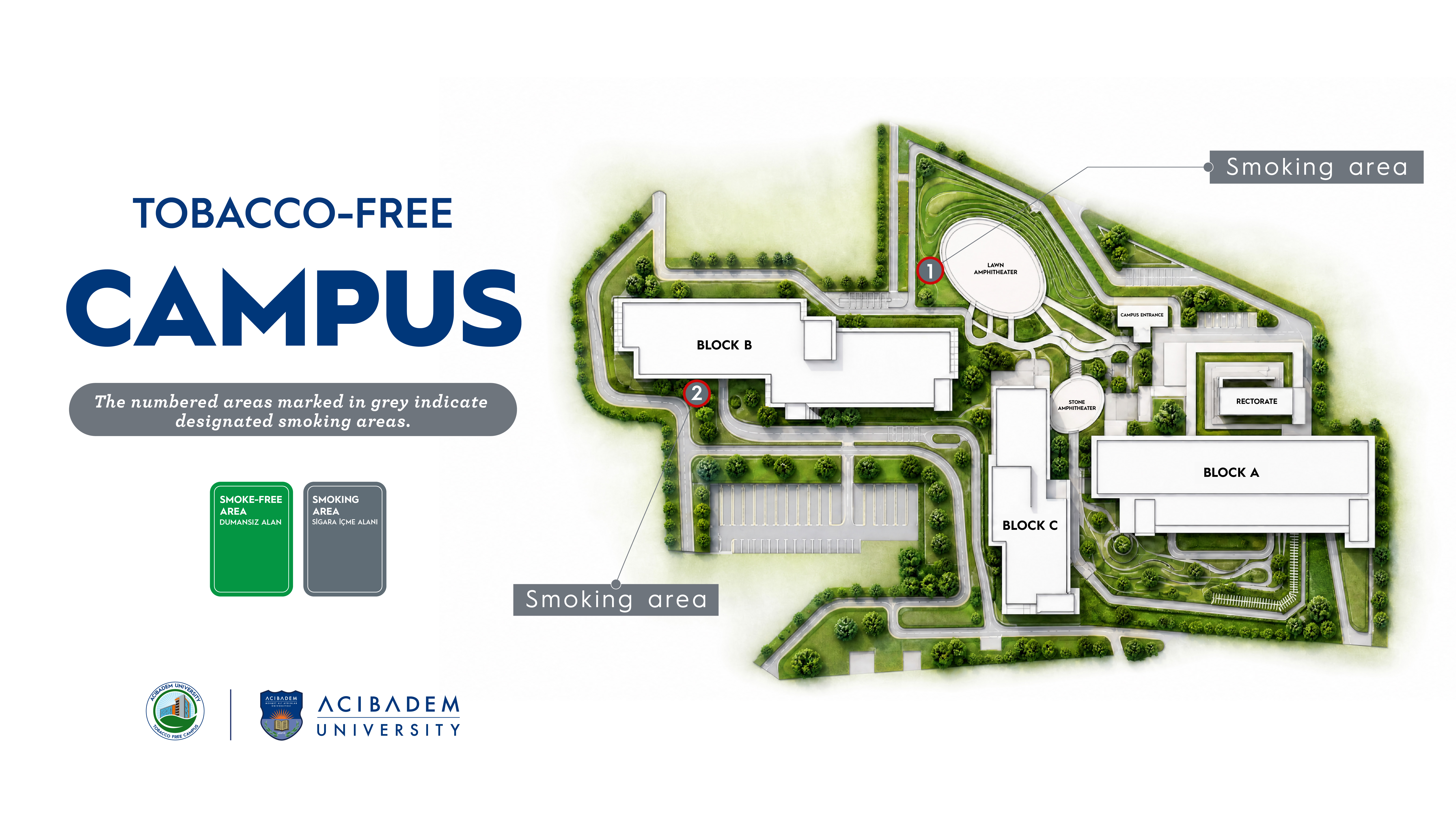




Acıbadem Mehmet Ali Aydınlar University has implemented the Smoke-Free Campus initiative to support the creation of a healthy, safe, and sustainable campus environment.
The Tobacco-Free Campus initiative aims to protect our students, academic and administrative staff, and visitors from the harmful effects of tobacco and tobacco products including exposure to tobacco smoke; to promote a culture of healthy living; and to raise public awareness on this issue.
In accordance with Senate Decision No. 2026-16, the Tobacco-Free Campus initiative entered into effect on August 24, 2026.
Under the initiative, the use of tobacco and tobacco products is prohibited in areas designated by the University.
Support and Contact
You can send your comments, suggestions, and questions regarding the Tobacco-Free Campus initiative to the Tobacco-Free Campus Commission.
Email: tutunsuzkampus@acibadem.edu.tr
Tobacco-Free Campus Commission
The Tobacco-Free Campus Commission carries out activities to ensure the effective implementation, development, and monitoring of the initiative across the University.
The Commission is responsible for planning awareness and information activities, evaluating feedback regarding implementation, and coordinating with the relevant academic and administrative units.
Commission Members
Chair
- Prof. Güldal Süyen
Members
- Prof. Nadi Bakırcı
- Prof. Murat Kurt
- Prof. Çağlar Çuhadaroğlu
- Assoc. Prof. Neşeriz Yeşim Yasin Erkmen
- Assoc. Prof. Figen Demir
- Assoc. Prof. Rengin Reis
- Assoc. Prof. Zeynep Tokçaer Keskin
- Fehmi Seda Tezkan
- Mesut Saygın
- Mehmet Ay
- Selçuk Marangoz
- Pelin Ulca
- Ceren Çelik
- Arhan Kurt
- Atalay Hoylu
Purpose
The purpose of this Policy is to establish a healthy, safe, and sustainable environment for students, employees, and visitors on the University campus; to reduce health risks associated with the use of tobacco products; to support environmental sustainability; and to strengthen the University’s alignment with national and international health policies, in line with the acception of health promotion as an institutional priority at Acibadem University.
In line with its commitment to social responsibility, the University recognizes the promotion of a healthy lifestyle culture and the development of a campus model compatible with sustainable development goals as an institutional obligation.
Rationale
The World Health Organization (WHO) identifies tobacco use as one of the leading preventable causes of death and highlights its adverse impacts on health, social well-being, and environmental sustainability. In Türkiye, tobacco use—particularly among young populations—remains at levels that require significant public health attention.
The WHO Framework Convention on Tobacco Control (FCTC) provides a framework that promotes smoke-free public environments and the strengthening of education and awareness activities, while supporting international human rights standards such as the right to health and the right to a safe living environment.
Within the scope of the United Nations 2030 Agenda, the Sustainable Development Goals (SDGs) encourage the strengthening of tobacco control measures. SDG 4 recognizes healthy learning environments as a prerequisite for quality education, while SDG 12 and SDG 13 support efforts to reduce the environmental impacts of tobacco production and waste.
As a health-oriented university, and in line with our institutional approach that recognizes health as a fundamental human right, establishing a safe, healthy, and sustainable campus environment is one of our primary responsibilities. This Policy will serve protecting the right to health and to establish an institutional framework aligned with international obligations.
Scope
This Policy applies to all University campuses, including all indoor and outdoor areas, buildings, dormitories, social facilities, sports facilities, parking areas, and all vehicles owned or operated by the University. It also applies to all tobacco products, Electronic Nicotine Delivery Systems (ENDS) which include, but are not limited to, electronic cigarettes (e-cigarettes), vape devices, vaporizers, vape pens, e-cigars, e-pipes, and all similar electronic devices designed for nicotine delivery, and Electronic Non-Nicotine Delivery Systems (ENNDS), which include electronic devices that do not contain nicotine but are similar to ENDS in terms of their method of use, appearance, and aerosol exposure, and that are used through inhalation.
Policy Principles
The use of tobacco products, ENDS, and ENNDS is not acceptable within University campus boundaries, except in areas designated by the University administration.
This Policy applies to all students, academic and administrative staff, subcontracted employees, and visitors.
During the transition period towards achieving a tobacco-free campus, designated smoking areas shall be established on campus.
All University events (including congresses, seminars, ceremonies, and similar activities) shall be organized as tobacco-free events.
Supportive Measures
Smoking cessation counseling and referral services shall be provided.
Informative and awareness-raising educational activities shall be conducted.
Visible warning and information signs shall be installed throughout the campus.
Implementation and Monitoring
The implementation of this Policy shall be carried out under the coordination of the Rectorate by the relevant units and/or committees. The effectiveness of the Policy shall be evaluated at regular intervals, and necessary improvements shall be made.
The procedures and principles regarding the implementation of this Policy shall be regulated through the Tobacco-Free Campus Implementation Directive to be issued by the University.
Tobacco-Free Campus Directive
The Acıbadem Mehmet Ali Aydınlar University Tobacco-Free Campus Directive sets out the scope and fundamental principles of the initiative, the procedures governing its implementation, and the responsibilities of the relevant parties.
The current version of the Directive is available via the link below.
View the Tobacco-Free Campus Directive
1. Is a complete ban on smoking on campus an infringement on personal freedoms?
The decisions and individual freedoms of adults are respected. However, the Tobacco-Free Campus Policy is not a coercive measure that disregards individual free will, nor is it an intervention in personal choices. Rather, it is a public health measure designed to protect the shared airspace on campus. While indoor smoking restrictions are important, efforts to create smoke-free outdoor areas aim to safeguard the right of all members of the campus community to breathe clean air.
2. Could the smoking restrictions make it more difficult to concentrate during classes and lead to crowding or disorder at campus entrances?
Tobacco use is prohibited on campus outside the designated “area.” Individuals who wish to use tobacco or tobacco products are not required to leave the campus to do so. Support channels have also been developed for physiological and psychological difficulties, such as problems with concentration.
3. Why are fully isolated designated smoking areas—for example, in parking areas or specific outdoor amphitheaters—not being created?
Based on the size of our campus, two smoking areas can legally be designated. Accordingly, there will be only two marked smoking areas. Given the limited social spaces on campus, the aim is to create a coherent smoke-free environment and develop alternative, healthy spaces for social interaction rather than allowing smoking areas to become social gathering points.
4. Is it unfair for academic and administrative staff to smoke on office balconies or terraces? How will this be monitored?
The Tobacco-Free Campus policy applies to everyone, without distinction between academic staff, administrative staff, and students. The policy covers all indoor and outdoor areas, including offices, balconies, fire escapes, and parking lots, except for the areas designated on the Smoke-Free Campus Map.
5. What are the exact boundaries of the initiative, and when will the process be finalized?
The initiative will take effect on August 24, 2026, and tobacco products may only be used in the two designated areas identified on the Smoke-Free Campus Map.
6. Will this policy fully address exposure to tobacco smoke in outdoor areas such as the lawn amphitheater and cafés?
Yes. Due to the compact size of the campus, individuals may be exposed to tobacco smoke even in outdoor areas such as A Plus Café, the lawn amphitheater, and shuttle/bus stops, which may cause discomfort including headaches, asthma-related symptoms, or the smell of smoke on clothing. Taking into account the difficulties that arise when smoking and non-smoking areas are not clearly separated, the new policy is intended to fully safeguard the right of everyone on campus to breathe clean air.
7. Will sanctions be imposed on those who violate the rules? Who will be responsible for monitoring compliance and issuing warnings?
The procedures regarding inspections, warnings, and violations are clearly outlined in Chapter 4 of the Directive.
8. We support the Tobacco-Free Campus initiative; however, how will potential crowding in surrounding outdoor areas be prevented from disturbing the neighborhood?
Planning for appropriate notices and arrangements in the areas surrounding the campus will also form part of the process.
8. What will be done to support the initiative, help those who wish to quit smoking, and raise awareness?
Students are expected to take an active role in the process through collaborations with student clubs and communities such as the Addiction, Sports, Music, and Green Crescent clubs. Plans under consideration include broadcasting public service announcements on campus, supporting communication efforts through posters and brochures, and organizing seminars led by experts for individuals who wish to quit smoking (e.g., Emre Üstünuçar / the Allen Carr method). In addition, free support services designed to encourage smoking cessation are being planned through the University Health Center.