
Our educational program is structured based on a student-centered and competency-based approach, offering a comprehensive set of teaching methods that address diverse learning objectives within an integrated framework. In addition to traditional lectures, contemporary educational approaches that promote active learning, integration, and application are systematically incorporated across all phases of the program.
• Case-Based Learning (CBL): This method is conducted through clinical scenarios adapted from real-life situations, enabling students to integrate basic and clinical sciences while strengthening their diagnostic reasoning, clinical decision-making, and evidence-based practice skills. Active participation is encouraged through discussion-based sessions.
• Team-Based Learning (TBL): This structured method consists of pre-class preparation, individual readiness assurance tests, team assessments, and application phases. It enables students to actively engage in learning processes while developing problem-solving, analytical thinking, and effective teamwork skills. The process is supported by feedback mechanisms.
• Problem-Based Learning (PBL): Currently under revision, this method is being enriched with AI-supported dynamic scenarios and learning environments. It aims to develop students’ self-directed learning, information-seeking, critical thinking, and clinical reasoning skills. In this process, instructors act as facilitators.
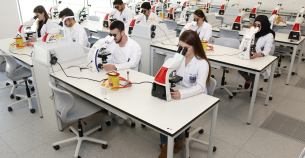
• Laboratory Practices: These activities reinforce theoretical knowledge in the basic sciences through experimental and practical applications. Students have the opportunity to directly observe and experience biomedical processes while developing scientific thinking and analytical skills.
• Field Studies: Conducted within a community-based education framework, these practices enable students to observe healthcare services on-site, assess community health needs, and understand the social, environmental, and economic determinants of health from a holistic perspective.
• Simulated Clinical Practice: Simulation-based training is conducted within the Advanced Medical Simulation and Education Center (CASE). CASE stands out internationally with its medical simulation education modalities and strong technological infrastructure and is considered among the top three centers worldwide. It is also the only center in Türkiye that includes an Advanced Endoscopic and Robotic Surgery Training Center within its structure.
The main objective of undergraduate education programs conducted at CASE is to equip students with both fundamental clinical skills and competencies in clinical decision-making, team management, and communication within safe and controlled environments. Clinical competencies are supported through standardized patient applications, high-fidelity simulators, and scenario-based training.
Through the advanced software infrastructure used at the center, students’ learning processes can be individually monitored from e-learning to post-simulation evaluation stages. Data obtained from camera systems, simulators, and medical devices in the simulation environment are transmitted to instructors, enabling detailed analysis of student performance and structured feedback.
For detailed information, please visit the CASE webpage via the link provided.
• Bedside Teaching: Conducted in real patient settings under faculty supervision, this method aims to develop students’ clinical competencies, patient assessment and management skills, professional attitudes, and ethical approaches. Students support their professional identity formation by experiencing a patient-centered care approach.
• Interprofessional Education (IPE): This approach enables students from different health disciplines to learn together and aims to develop communication, collaboration, and role awareness skills necessary for team-based healthcare delivery. Students experience the contributions of different professional groups and understand the importance of effective teamwork in improving patient safety and quality of care.
These teaching methods are implemented progressively across the phases of the program, aiming to support students’ balanced and sustainable development in knowledge, skills, and professional attitudes.