


The primary goal of medical education is to train physicians who understand the health problems of society, can develop effective solutions to these problems, and contribute to the prevention and promotion of health. Therefore, medical schools are responsible for planning their educational programs in a way that responds to the real health needs of the communities they serve.
The responsibility of medical schools to direct their education, research, and service activities toward addressing the priority health concerns of the communities they serve has been conceptualized by the World Health Organization as social accountability (Boelen C, Heck J, 1995).
This approach requires medical schools not only to provide high-quality education, but also to graduate physicians who are relevant, effective, and responsive to societal needs.
The Acıbadem University School of Medicine (ACUSoM) acts with a strong awareness of its social obligations. It has identified activities in this domain as priority goals and has allocated substantial emphasis to them in its Strategic Plan (2022–2026).
“Conducting activities that respond to the health needs of society and strengthening collaborations” is explicitly stated in the ACUSoM’s mission.
Within this framework, under the heading of “Focus on Social Obligations,” the following priorities have been defined:
The social obligations of the School of Medicine are shaped by a commitment to being responsible, responsive, and accountable in education, research, and service in a way that addresses the priority health concerns of society. Strengthening graduates’ competencies in this domain, enhancing the societal impact of research, contributing to public health, and establishing collaborations and partnerships with key stakeholders in health and social sectors are identified as priority goals across different strategic areas of the Plan.
To achieve these goals, the ACUSoM aims to first build awareness among all stakeholders and strengthen a culture of social accountability at the institutional level. Additionally, alignment with the United Nations Sustainable Development Goals (SDGs) is emphasized.
Accordingly:
- An institutional structure has been established to monitor social accountability activities.
- An institutional self-evaluation has been conducted.
- A community engagement policy and action plan have been developed and implemented.
These initiatives have also been evaluated by the Association for Evaluation and Accreditation of Medical Education Programs (TEPDAD) and recognized as an example of good practice within the strategic planning process.
The ACU adopts a responsible, responsive, and accountable approach in education, research, and service in line with its social accountability mission.
The main strategic objectives are as follows:
Education
- Focusing on the health needs of society and strengthening the integration of relevant physician roles into the curriculum (community-oriented medical education)
- Prioritizing efforts to strengthen community-based medical education.
- Increasing the presence of community-oriented projects within the curriculum.
- Enhancing the curriculum in relation to climate change and sustainability.
Societal Impact
- Strengthening graduate tracking systems to monitor the impact of medical education on society.
- Conducting regular qualitative and quantitative studies to identify graduate needs.
Research
- Evaluating the societal impact of research.
- Increasing studies that respond to societal needs, can be translated into products, or influence health policy.
- Community Engagement and Partnerships.
- Expanding societal impact by strengthening partnerships aimed at addressing priority community needs.
- Enhancing collaboration with institutions involved in healthcare delivery.
Institutional Development
- Increasing awareness of social accountability and strengthening institutionalization.
- Developing and implementing a community engagement policy and action plan.
- Establishing and implementing an institutional monitoring strategy.

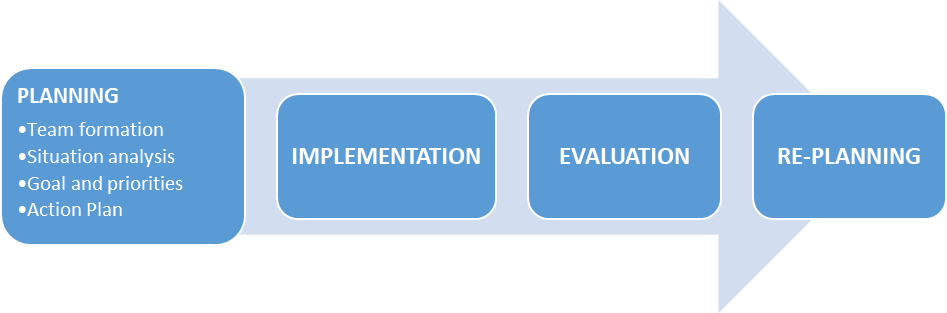

We are here
Timeline of Activities:
- 2020 – Agenda item in Curriculum Committee and Faculty Board
- 2021 – Strategic planning with participation of all stakeholders
- 2022 – Strategic Plan finalized and shared with stakeholders
- 2023 – Establishment of working groups
- 2024 – Institutional self-evaluation and development of Action Plan
- 2024 – Approval of Action Plan by Faculty Board and dissemination to stakeholders
Social Accountability Working Group
The Social Accountability Working Group was established in 2023 to conduct institutional self-evaluation and develop policy and an action plan.
The Social Accountability Working Group Members | |
Prof. Dr. Nadi Bakırcı | Dean/ Department of Public Health |
Prof. Dr. İlhan Cem Sungur | Department of Medical Education |
Doç. Dr. Levent Altıntaş | Department of Medical Education |
Doç. Dr. Figen Demir | Department of Public Health |
Dr. Kaan Mert Güven | Department of Medical Education, PhD Students |
Fatma Yağız | Faculty Secretary |
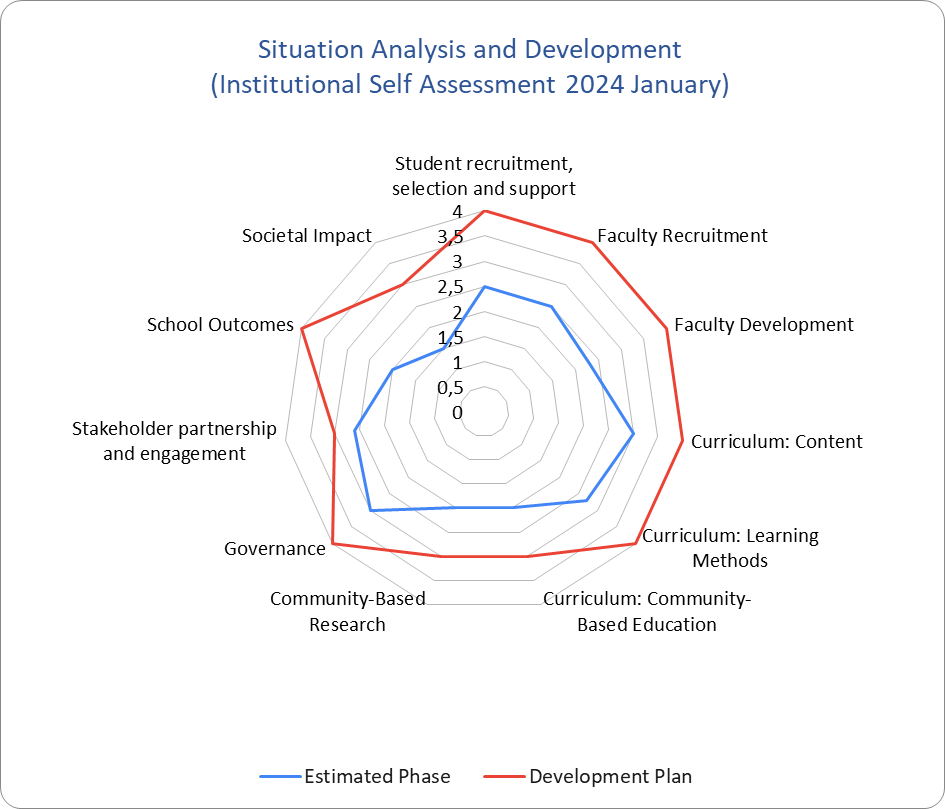
The Faculty’s level of social accountability has been assessed using the internationally validated
Indicators for Social Accountability Tool in Health Profession Education (ISAT)
Indicators for Social Accountability Tool in Health Profession Education
The evaluation was conducted across the following domains:
- Students
- Faculty
- Educational program
- Research
- Governance
- Stakeholder partnerships and engagement
- Institutional outputs
- Societal impact
Each criterion was assessed across four developmental phases:
- Phase 1: Criterion not met
- Phase 2: Initial efforts toward meeting the criterion
- Phase 3: Criterion defined and implemented
- Phase 4: Advanced implementation
Based on institutional and societal needs, resources, opportunities, and barriers, the current status, current phase, areas for development, and target phase were defined for each domain.
Click here for the full text.
Based on the Social Accountability Evaluation Report, an Action Plan was developed by the Dean’s Office and approved by the Faculty Board.
The Action Plan includes:
- Strategic priorities
- Defined objectives
- Justifications
- Responsible units
- Short-, medium-, and long-term actions
The plan was developed using both the ISAT framework and national guidelines such as TEPDAD Social Accountability Indicators (2019).
Click here for the full text of the Action Plan.
Evaluating and enhancing the societal impact of research is a key strategic priority of the Faculty.
To support this, the Social Impact of Research Working Group was established in 2023 and focuses on:
Developing a monitoring strategy aligned with faculty goals
Increasing visibility of high-impact research and researchers
Promoting community-based research
Integrating with periodic academic performance evaluation systems
Research impact is assessed based on whether it:
- Leads to useful products or methods
- Addresses priority health problems of society
- Influences policy (e.g., inclusion in clinical or policy guidelines)
ACUSoM prioritizes strengthening community-oriented and community-based approaches in education, ensuring that graduate competencies are monitored in alignment with societal needs, evaluating the societal impact of research, and aligning with the Sustainable Development Goals. This holistic approach enhances the Faculty’s social accountability and responsiveness, ensuring that institutional goals are focused on societal benefit.
Opportunities for learning within the community are provided from the early years of the program. Within the Clinical Medicine and Professional Skills (CMPS) Program, students engage in community-based activities through the “Health and Society” courses, where they establish early contact with the community by conducting fieldwork in Family Health Centers starting from Year 1. In Year 3, this experience is further expanded through regular weekly observation and practice activities. During the internship period, students actively participate in community health practices through the eight-week Community Health and Primary Care Internship Program.
This program is implemented through the “Health, Education, and Research Regions (SEAB) Protocol,” established between the Acıbadem University and the Istanbul Provincial Health Directorate. Within this framework, planning and implementation are carried out in collaboration with local health institutions. Family physicians working in primary care facilities in two districts of Istanbul (Ümraniye and Küçükçekmece) serve as field educators in the program.