The education program of Acıbadem University School of Medicine consists of distinctive, complementary components within a competency-based, integrated, and student-centered structure.
Phase I – Pre-Clinical Period (Years 1–3)
It consists of integrated course committees designed based on organ systems. Students learn basic and clinical sciences together; in addition, they gain knowledge and competencies in the fields of ethics, humanities, research methods, public health, professionalism, and clinical skills.
Phase II – Clinical Period (Years 4–5)
Students gain experience in patient management, differential diagnosis, treatment, and participation in healthcare services through compulsory and elective clerkships conducted in clinical settings. Clerkships are structured either as single-discipline rotations or as integrated blocks combining related disciplines.
Phase III – Internship Period (Year 6)
In this period, conducted with a “learning by doing” approach, students take an active role in patient diagnosis, treatment, and follow-up processes and acquire the physician competencies defined for undergraduate medical education.
Course Categories
Integrated Medical Courses: Consist of Biomedical Science Committees (BSC) and Clinical Medicine and Professional Skills (CMPS) programs.
Complementary Medical Courses: Include compulsory (e.g., Medical English, Biostatistics) and elective (e.g., Social Responsibility, Medical Language Proficiency) courses.
Common Courses: Courses offered at the university level.
Transition to Clinical Clerkships Program (TCC): A preparatory module for clinical practice.
Clinical Clerkships: Compulsory and elective practices in the 4th and 5th years.
Internship Programs: Compulsory and elective practices carried out during the 6th year.
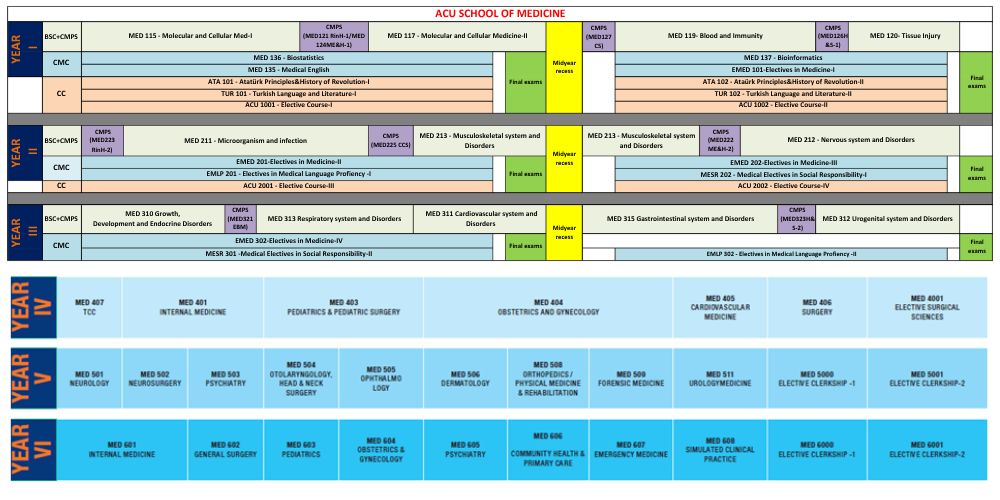
a) Biomedical Science Committees (BSC): The aim of the Biomedical Science Committees is to provide an understanding of the normal structure and function of the human body, explain pathological changes related to diseases, develop the ability to establish relationships between major diseases and their underlying mechanisms, and raise awareness of preventive medicine and preventive approaches. In the early years of the program (Years 1–3), basic and clinical sciences are delivered in an integrated manner within system-based course committees. This structure aims to ensure early acquisition of clinical context through horizontal and vertical integration.
Year 1:
• MED 115 Molecular and Cellular Medicine - I: This committee aims to enable students to understand biological processes at the cellular and molecular level and to develop basic competencies that allow them to use this knowledge in a clinical context. The committee covers cell structure and functions, biomolecules, the structure and transmission of genetic information, regulation of gene expression, principles of heredity, and basic histological organization. In addition, students are expected to explain the molecular basis of genetic variation and diseases, acquire microscopic evaluation skills, and develop familiarity with basic molecular genetics methods. Click for detailed information.
• MED 117 Molecular and Cellular Medicine - II: This committee aims to enable students to understand the cell membrane, cellular signal transduction, basic metabolism, and early embryonic development processes. The committee covers membrane structure and transport mechanisms, homeostasis, cellular communication, enzymes and metabolic pathways, and early developmental stages. In addition, it aims to develop skills related to basic laboratory applications. Click for detailed information.
• MED 119 Blood and Immunity: This committee aims to enable students to understand the basic structure and function of the blood and immune systems and to comprehend the clinical significance of diseases related to these systems. The committee covers the components of blood, hematopoiesis, and fundamental processes related to the structure and function of the immune system. In addition, it aims to raise awareness of the basic mechanisms and diagnostic approaches of blood disorders, particularly anemias. Click for detailed information.
• MED 120 Tissue Injury: This committee aims to enable students to understand the pathological and molecular mechanisms of cancer and to relate these processes to diagnosis, epidemiology, and prevention approaches. The committee covers cellular injury, inflammation, neoplasia, tumor biology, and the genetic and molecular basis of cancer. In addition, it aims to raise awareness of cancer development, mechanisms of spread, risk factors, and basic prevention and screening approaches. Click for detailed information.
Year 2:
• MED 211 Microorganisms and Infection: This committee aims to provide students with basic knowledge and skills related to microbiology and infectious diseases. The committee covers the structure and classification of microorganisms, pathogenesis, mechanisms of infectious disease development, and principles of diagnosis and prevention. In addition, it aims to raise awareness of the basic principles of antimicrobial therapy, laboratory applications, and the global dimension of infectious diseases. Click for detailed information.
• MED 213 Musculoskeletal System and Related Disorders: This committee aims to enable students to understand the normal structure and function of the musculoskeletal system and to evaluate common pathological conditions related to this system in a clinical context. The committee covers the anatomical, biomechanical, and biochemical characteristics of the musculoskeletal system, as well as diagnostic methods and basic disease processes. In addition, it aims to help students relate clinical findings to underlying mechanisms and develop awareness of basic treatment approaches. Click for detailed information.
• MED 212 Nervous System and Related Disorders:This committee aims to enable students to understand the normal structure and function of the nervous system and to relate pathological changes in this system to clinical findings. The committee covers the anatomical, physiological, and biochemical characteristics of the nervous system, as well as basic disease processes. In addition, it aims to help students recognize the clinical manifestations of neurological diseases and develop awareness of basic diagnostic and treatment approaches. Click for detailed information.
Year 3:
• MED 310 Endocrine System and Related Disorders: This committee aims to enable students to understand the normal structure and function of the endocrine system and the processes of growth and development, and to relate pathological changes in these processes to clinical conditions. The committee covers the structure and mechanisms of action of hormones, characteristics of endocrine organs, and the basic processes of growth and development. In addition, it aims to raise awareness of the basic mechanisms of endocrine system diseases and growth and developmental disorders, as well as approaches to treatment and prevention.
• MED 313 Respiratory System and Related Disorders: This committee aims to enable students to understand the normal structure and function of the respiratory system, to comprehend pathological changes in this system, and to relate them to clinical findings. The committee covers the anatomy and physiology of the respiratory system, ventilation–perfusion relationships, infections, and basic disease processes. In addition, it aims to raise awareness of diagnostic approaches, radiological evaluation, and treatment methods. Click for detailed information.
• MED 311 Cardiovascular System and Related Disorders: This committee aims to enable students to understand the normal structure and function of the cardiovascular system and to relate pathological changes in this system to common cardiovascular diseases. The committee covers the anatomical, physiological, and hemodynamic characteristics of the heart and vascular system, as well as basic disease processes. In addition, it aims to raise awareness of diagnostic methods, laboratory findings, and treatment approaches. Click for detailed information.
• MED 315 Gastrointestinal System and Related Disorders: This committee aims to enable students to understand the structure and function of the gastrointestinal system, recognize common diseases, and relate them to clinical findings. The committee covers the anatomical and physiological characteristics of the gastrointestinal system, basic disease processes, and the microbiota. In addition, it aims to raise awareness of diagnostic methods, treatment approaches, and the public health dimension. Click for detailed information.
• MED 312 Urogenital System and Related Disorders: This committee aims to enable students to understand the normal structure and function of the urogenital system and to relate pathological changes in this system to common urogenital diseases. The committee covers the anatomical and physiological characteristics of the urinary and reproductive systems, basic disease processes, and reproductive health. In addition, it aims to raise awareness of diagnostic methods, laboratory applications, and treatment approaches. Click for detailed information.
(b) Clinical Medicine and Professional Skills Program (CMPS): The aim of the Clinical Medicine and Professional Skills Program is to support the development of students’ professional identity, enable them to acquire effective communication and clinical skills, enhance their ability to make decisions in line with ethical values and humanistic approaches, support their acquisition of basic knowledge and skills related to scientific research processes, and enable them to evaluate the relationship between health and society from a holistic perspective.
The program consists of the following course committees: Health and Society, Research in Health, Medical Ethics and Humanities, and Communication and Clinical Skills. It is structured as a spiral curriculum progressing from simple to complex over the first three years, supporting interdisciplinary and vertical integration. Within this framework, students are also supported through various learning experiences such as early clinical exposure, community-based learning, and interprofessional education.
Year 1:
• MED 121 Research in Health - I: This course aims to enable students to develop scientific thinking skills and acquire basic concepts related to medical research methodology. The course covers the development of scientific thinking, research methods, epidemiology, and principles of causality. In addition, it aims to raise awareness of research ethics, scientific integrity, and plagiarism. Click for detailed information.
• MED 124 Medical Ethics and Humanities - I: This course aims to provide students with basic knowledge and awareness of human rights, the right to health, and medical ethics. The course covers the historical development of medicine, the role of physicians, and the physician–patient relationship. In addition, it aims to help students understand ethical decision-making processes and develop awareness of the social responsibilities of the medical profession. Click for detailed information.
• MED 126 Health and Society - I: This course aims to enable students to understand the social, cultural, economic, and political determinants of health and disease, and to gain knowledge about primary healthcare services in Türkiye. The course covers medical sociology, health inequalities, perceptions of illness, and healthcare systems. In addition, it aims to help students develop a community-based perspective and evaluate patient experiences within a social context. Click for detailed information.
• MED 127 Communication Skills: This course aims to enable students to acquire basic knowledge and skills in basic life support and first aid, effective communication, patient-centered care, and infection control. The course covers communication skills, empathy, self-awareness, stress management, and teamwork. In addition, it aims to raise awareness of fundamental practices that support safe and effective care in clinical settings. Click for detailed information.
Year 2:
• MED 223 Research in Health - II: This course aims to enable students to acquire basic knowledge and skills for planning, conducting, and presenting a medical research project. The course covers developing a research question, study design, data collection, and analysis processes. In addition, it aims to raise awareness of research ethics and scientific reporting principles. Click for detailed information.
• MED 225 Clinical Communication Skills: This course aims to enable students to communicate effectively with patients, patients’ relatives, and caregivers, and to take patient histories using a patient-centered approach. The course covers the basic structure of physician–patient interaction, verbal and non-verbal communication skills, and empathy. In addition, it aims to help students develop a respectful, sensitive, and patient-centered communication approach based on ethical values. Click for detailed information.
• MED 222 Medical Ethics and Humanities - II: This course aims to enable students to understand patients’ rights, the ethical and legal responsibilities of physicians, and to evaluate ethical issues related to the beginning and end of life. The course covers patient rights, informed consent, professional values, and ethical dilemmas. In addition, it aims to raise awareness of ethical issues related to new medical technologies. Click for detailed information.
Year 3:
• MED 321 Evidence-Based Medicine: This course aims to enable students to understand the principles of evidence-based medicine, develop the ability to critically appraise medical literature, and effectively use it in clinical decision-making processes. The course covers the evaluation of research methods, levels of evidence, and the concepts of validity and bias. In addition, it aims to enable students to effectively manage difficult patient encounters and sensitive issues through communication skills. Within this scope, it aims to raise awareness of breaking bad news, behavior change, and patient-centered care. Click for detailed information.
• MED 323 Health and Society - II: This course aims to enable students to observe primary healthcare services in practice, develop basic clinical skills, and gain fundamental knowledge of healthcare systems and health economics. The course covers basic physical examination skills, effective communication with patients, the structure and functioning of healthcare systems, and healthcare delivery processes. In addition, it aims to help students understand the social dimension of healthcare services, health policies, and the basic principles of health economics, and to assess health needs at both individual and community levels. Click for detailed information.
It consists of compulsory and elective medical courses aimed at enabling students to acquire fundamental knowledge and skills that support medical education, while enriching their individual development through elective courses aligned with their interests.
a) Compulsory Medical Courses:
• MED 136 Biostatistics: This course aims to enable students to understand basic statistical methods and use them in the analysis of medical data. The course covers descriptive statistics, hypothesis testing, sampling methods, and regression analysis. In addition, it aims to help students acquire the ability to analyze real medical data using the R programming language. Click for detailed information.
• MED 137 Bioinformatics: This course aims to enable students to understand basic concepts in bioinformatics and learn fundamental methods for the analysis of biological data. The course covers sequence analysis, database usage, genomic approaches, and phylogenetic analyses. In addition, it aims to help students approach the molecular basis of diseases from different perspectives using bioinformatics tools.Click for detailed information.
• MED 135 Medical English - I: This course aims to enable students to acquire basic language skills in professional and academic English to support their medical education. The course covers medical terminology, comprehension of written and spoken medical texts, and professional communication skills. Click for detailed information.
b) Elective Medical Courses:
• Electives in Medicine (EMED) I-II-III: This program is designed to support students in developing in-depth interest and competence in various fields such as medicine, basic sciences, bioinformatics, medical engineering, and humanities. Within EMED, students are encouraged to direct their learning according to their interests, develop research skills, and gain an interdisciplinary perspective. In addition, students are supported in their development as independent learners, researchers, and health advocates, contributing to their academic and professional growth.
• EMLP 201, EMLP 302 Electives in Medical Language Proficiency I-II: This elective course corridor aims to advance students’ existing medical English skills to a higher level and enable them to use them effectively in a professional context. The courses are structured as one semester each in the 2nd and 3rd years according to students’ individual needs and development goals. The corridor covers the development of professional oral communication skills, academic medical writing, and professional English usage. In addition, Turkish language courses offered for international students aim to support communication skills in clinical and social settings. Click for detailed information.
• MESR 202, MESR 301 Medical Electives in Social Responsibility: This course aims to develop students’ awareness of social responsibility and equip them with the ability to generate solutions for community-based health and social issues. Within the course, students actively participate in processes of project development, implementation, and evaluation by assessing the health and social needs of society. In addition, it aims to develop students’ empathy, teamwork, leadership, and health advocacy skills. This process also supports students in understanding different social contexts and working in multidisciplinary collaboration. Click for detailed information.
You can access the Student Guide, which contains detailed instructions regarding the courses, here.
It consists of compulsory and elective common courses designed to support students in gaining general culture, social awareness, and university-level core competencies.
a) TUR 101, TUR 102 Turkish Language I & II: This course aims to enable students to acquire knowledge and skills related to the correct and effective use of the Turkish language and to understand the impact of language on cultural development. The course covers rules of written expression, grammar, punctuation, and expression disorders. In addition, it aims to develop students’ reading, comprehension, and written expression skills. Click for detailed information.
b) ATA 101, ATA 102 Principles of Atatürk and History of the Turkish Revolution I & II: This course aims to enable students to understand the modernization process in its historical and global context. The course covers modernization movements in Europe, the Industrial Revolution, and political transformations. In addition, it aims to raise awareness of the historical and social foundations of the establishment process of the Republic of Türkiye and the principles and reforms of Atatürk. Click for detailed information.
c) University Common Elective Courses: University common elective courses aim to enable students to diversify their knowledge and skills by taking courses from different disciplines according to their interests and needs. These courses support students’ critical thinking, communication, cultural awareness, and lifelong learning skills. In addition, they contribute to the development of students’ academic and personal competencies by promoting their multidimensional development.
MED 407 Transition to Clinical Clerkships: The Transition to Clinical Clerkships Program is a mandatory training program structured to prepare students for clinical clerkships at the beginning of the 4th year. The program extends hospital orientation to support students in adapting safely and effectively to the clinical environment. Within the TCC, students develop skills in history taking, physical examination, basic procedural skills, and clinical reasoning through simulation-based practice, while also gaining knowledge of hospital information management systems, workflow processes, and patient safety practices. In addition, students have the opportunity to observe healthcare delivery in a multidisciplinary setting alongside physicians, nurses, and other healthcare professionals. The program supports students in understanding their roles in the clinical environment, recognizing their professional responsibilities, and adapting to teamwork, while also raising awareness of fundamental hospital rules and practices. Click for detailed information.
The clinical clerkship period, which covers the fourth and fifth years of the medical education program, aims to enable students to develop their knowledge and skills through observation and supervised practice in clinical settings. During this process, students develop clinical reasoning skills by observing patient assessment, diagnosis, and treatment processes across different clinical disciplines and have the opportunity to evaluate healthcare delivery from a holistic perspective. In Phase II, some clerkships are conducted as single-discipline rotations, while others are organized as integrated blocks combining related disciplines.
Sınıf 4
Sınıf 5
The internship period, the final year of medical education, is a transition phase in which students actively participate in medical practice and consolidate their knowledge, skills, and professional attitudes. During this period, students take responsibility as part of clinical teams and engage in patient care processes, further developing their competencies in medical practice. The internship program is structured to include rotations in core clinical disciplines, primary healthcare experience, and emergency patient management.
Within the program, Simulated Clinical Practice sessions allow students to reinforce their clinical skills in a safe environment, while elective internships support students in deepening their knowledge in areas of interest.
This structure aims to prepare students for independent medical practice before graduation, enable them to take an active role in clinical decision-making processes, and assume their professional responsibilities.