Frequently searched keywords:
Frequently searched keywords:


Haber tarihi: 17/04/2026
Last update date: 17.04.2026
Antibiotic resistance is widely recognized as one of the most serious threats facing global health systems today. According to data from the World Health Organization, approximately 1.27 million people die each year as a direct result of antibiotic-resistant infections. Experts warn that, in the absence of effective measures, this figure may rise considerably in the years ahead. One of the primary drivers of this challenge is the frequent inability to promptly identify the correct antibiotic during the treatment of infections, which leads to the empirical administration of broad-spectrum agents. This approach can result in delays in appropriate treatment and contribute to the development of drug resistance among bacterial pathogens.
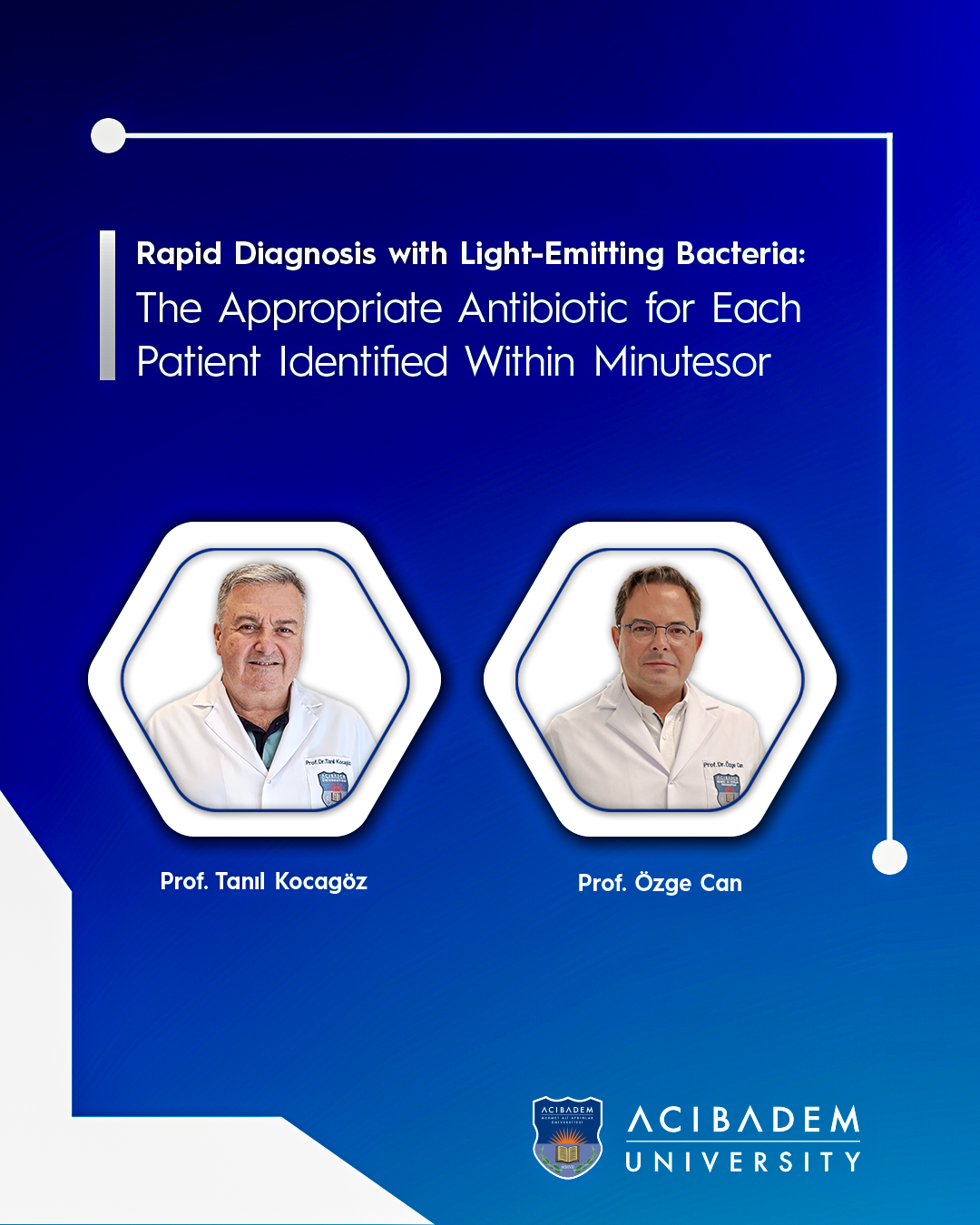
A novel technology with the potential to address this significant problem has been developed at Acıbadem University. The "Rapid Antibiotic Susceptibility Test," developed at Bio-T Biotechnology Solutions and Manufacturing Inc. a company co-founded by Prof. Tanıl Kocagöz, Head of the Department of Medical Microbiology at Acıbadem University School of Medicine, and Prof. Özge Can, Head of the Department of Biomedical Engineering at the Faculty of Engineering and Natural Sciences and housed within the Acıbadem University Technology Development Center, is capable of determining the antibiotic susceptibility profile of a patient's bacterial isolate within a very short period of time. In the test, bacteria killed by the antibiotic emit light through a specialized dye, thereby enabling rapid and clear identification of which antibiotic is effective. Through this rapid antibiotic susceptibility testing approach, the susceptibility determination process which would ordinarily require up to one day can be reduced to between 15 and 90 minutes. Laboratory studies have been completed, and the test is expected to enter clinical use in the near future.
Bacteria That Emit Light When an Antibiotic Is Effective
The developed test rapidly determines the susceptibility of the causative bacterium to various antibiotics, thereby identifying which agent will be effective for the patient. This allows clinicians to initiate the correct and effective treatment without delay. Prof. Tanıl Kocagöz describes the method as follows:
"In this method, we use a specialized dye that cannot enter a living bacterial cell through the cell membrane. The moment the bacterium dies as a result of antibiotic action, its membrane becomes permeable and the dye infiltrates the cell. Once inside, the dye binds to the bacterium's DNA and begins to emit light. This allows us to determine very rapidly whether the bacterium has been killed. In conventional tests, it was necessary to wait for the bacterium to proliferate and produce a visible turbidity in the culture medium a process that caused considerable delays. With our method, there is no need to wait; as soon as the bacterium dies, the dye enters and an immediate light signal is generated."
Noting that bacteria show no response in the presence of antibiotic resistance, Prof. Tanıl Kocagöz adds: "If the bacterium is resistant to the antibiotic being used and does not die, the dye cannot enter the cell and no light is produced. This enables us to rapidly determine that the antibiotic is ineffective for that particular patient — in other words, that the bacterium is resistant."
Initiating the Correct Treatment Within Hours
Rapid diagnostic methods of this kind are of particular importance in the current era, characterized by the widespread prevalence of hospital-acquired infections and a growing proportion of multidrug-resistant microorganisms. In intensive care units and in patients with compromised immune systems, timely access to the appropriate antibiotic is considered a critical determinant of treatment success.
Emphasizing the significance of the technology, Prof. Tanıl Kocagöz underscores the considerable time required by conventional methods to determine antibiotic susceptibility: "Until now, we had to wait at least one day to determine which antibiotic a bacterium is susceptible to. With the rapid antibiotic susceptibility test we have developed, we are reducing this timeframe to under one and a half hours a substantial gain in the management of infectious diseases."
A Significant Step Against Unnecessary Antibiotic Use
Drawing attention to the fact that inappropriate or unnecessary antibiotic use represents one of the leading causes of antibiotic resistance, Prof. Tanıl Kocagöz states: "Initiating treatment without knowing which antibiotic will be effective is often unavoidable. However, this situation can lead both to delayed access to appropriate treatment for the patient and to the development of resistance by the bacteria. The test we have developed aims to prevent unnecessary antibiotic use by enabling the rapid identification of the most appropriate antibiotic for each individual patient."
Prof. Özge Can, emphasizing that the test facilitates the use of the antibiotic most suited to the patient's specific infection, notes that the technology constitutes not merely a diagnostic method but a system that enhances treatment outcomes: "By preventing unnecessary antibiotic use, more effective treatment is ensured for the patient, and the spread of antibiotic resistance can be curtailed."
Reminding that broad-spectrum antibiotics are currently administered to many patients without awaiting test results, Prof. Özge Can further states: "Inappropriate or unnecessary antibiotic use not only complicates treatment but also drives the acquisition of antibiotic resistance in bacteria. The rapid antibiotic susceptibility test we have developed makes targeted, patient-specific treatment possible."
Also noting that the test may play an important role in combating hospital-acquired infections, Prof. Tanıl Kocagöz states that the system they have developed contributes to a personalized treatment approach, and identifies the inability to rapidly determine which antibiotic the causative bacterium is resistant to as one of the greatest challenges in the management of nosocomial infections.
Underlining that one of the further contributions of the new test lies in supporting the more rational use of antibiotics, Prof. Tanıl Kocagöz adds: "With this method, antibiotic selection is no longer based on estimation. A data-driven, patient-specific treatment plan can now be established."
An Important Step Toward Public Health
Work is ongoing to enable the broad clinical implementation of this rapid antibiotic susceptibility test a domestically developed technology whose laboratory phase has been completed. Prof. Özge Can states: "We want this technology to be available in hospitals as soon as possible. We are currently in discussions with the healthcare industry regarding its market introduction. Our goal is for this method to reach patients in the shortest possible time."
According to experts, rapid access to appropriate treatment in infectious diseases is of critical importance not only for individual patients but also for public health at large. Rapid antibiotic susceptibility tests are regarded as among the most important tools in the future fight against antibiotic resistance.
14 October 2026
School of Medicine
01 October 2026
School of Medicine, Histology and Embryology
23 September 2026
School of Medicine, Medical Microbiology