Frequently searched keywords:
Frequently searched keywords:


Haber tarihi: 09/06/2026
Last update date: 09.06.2026
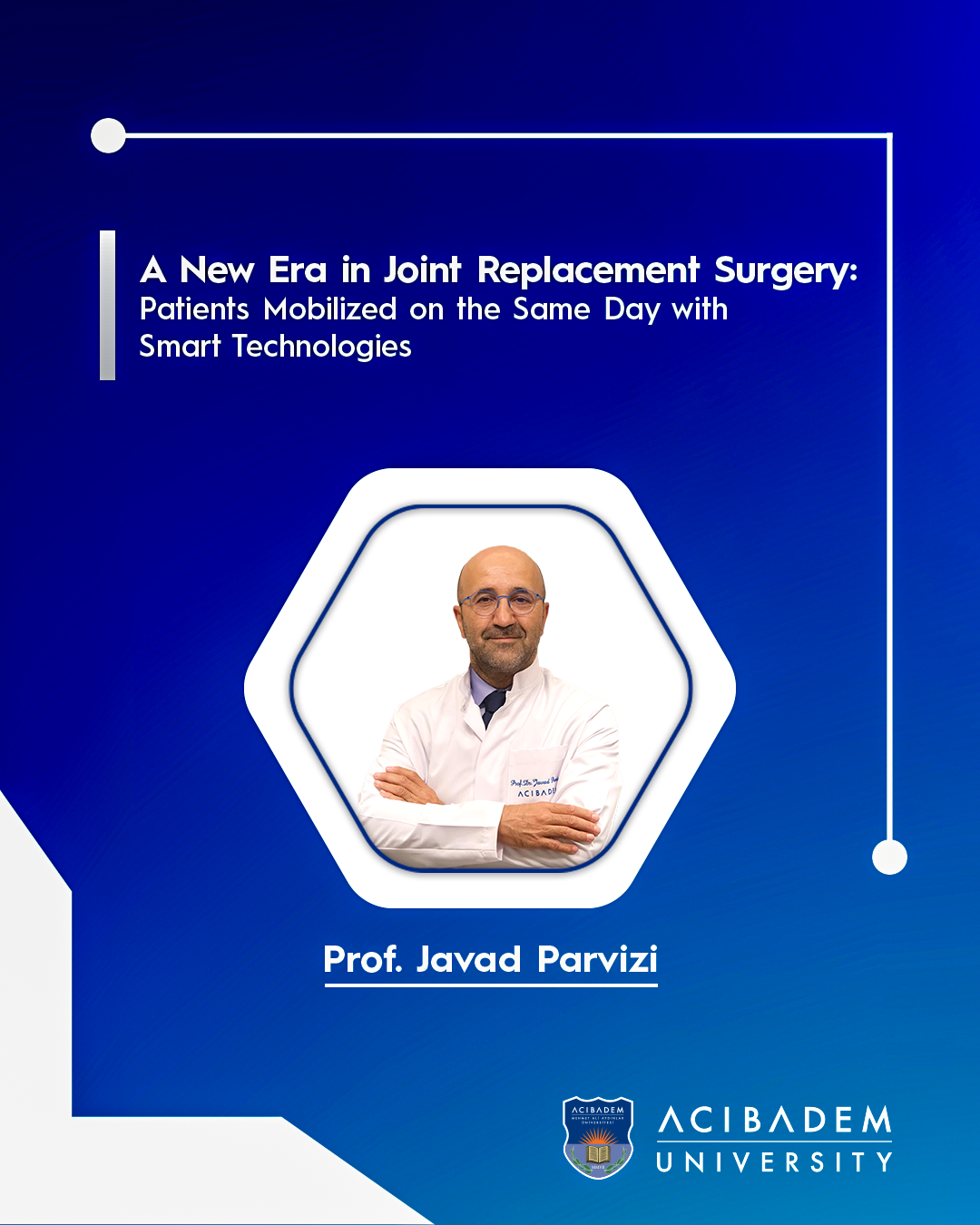
A New Era in Joint Replacement Surgery: Patients Can Stand the Same Day with Smart Technologies
Prof. Javad Parvizi, Faculty Member at Acıbadem University School of Medicine, Department of Orthopedics and Traumatology, Discusses Groundbreaking Developments in Orthopedics
Hip and knee replacement surgeries are among the most commonly performed orthopedic procedures worldwide. According to data from the World Health Organization, joint diseases and the related need for surgical treatment are increasing rapidly each year due to the aging population. Although hip replacement surgeries are highly successful in restoring mobility, complications such as infection, implant loosening, blood clot formation, and the migration of these clots to other parts of the body remain among the most critical issues in the treatment process.
Today, the field of orthopedics is undergoing a multifaceted transformation. New biomarker tests that enable infections to be detected within hours, preoperative digital planning methods, and more durable, biocompatible next-generation implants are among the key elements of this transformation. In addition, thanks to “rapid recovery” protocols, patients are able to stand much sooner after surgery. At the same time, safer medication approaches to reduce the risk of blood clots and personalized treatment planning are also improving success rates.
In this transformation, the work of Prof. Javad Parvizi, Faculty Member at Acıbadem University School of Medicine, Department of Orthopedics and Traumatology, and Founder of the Acıbadem University International Joint Health Application and Research Center, makes a significant contribution to ensuring that these innovations are reflected in clinical practice in a safer and more systematic way, particularly through methods that enable early diagnosis of infections and treatment algorithms centered on patient safety.
Although the infection rate in hip and knee replacements is around 1–2 percent, when infection occurs, the treatment process can become highly complex and challenging. Delayed diagnosis of infection may cause patients to undergo multiple surgeries and experience a longer recovery period. Prof. Javad Parvizi says, “Today, thanks to next-generation biomarker tests, infections can often be detected within hours.”
Early Diagnosis in Infection Saves Lives
The rapid and reliable diagnostic opportunity offered by next-generation biomarker tests is particularly important in the early postoperative period and enables treatment to begin without delay. Prof. Javad Parvizi’s contributions stand out among the significant developments in this field. By leading the development of international criteria used in the diagnosis of periprosthetic joint infections, Prof. Parvizi has helped clarify diagnostic processes. He has also played an important role in the clinical implementation and widespread use of biomarker tests performed on joint fluid.
Prof. Javad Parvizi summarizes the issue as follows: “In this way, we systematized which patients with infected implants should undergo one-stage surgery and which should undergo two-stage surgery, making treatment approaches more predictable and successful. As a result, success rates increased, and unnecessary surgeries could be avoided. Detecting infection early protects not only the implant but also the patient’s overall health. Today, compared to the past, we have much faster and more reliable diagnostic methods.”
Smart Technologies Support Surgery
In modern joint replacement surgery, digital planning, artificial intelligence-supported analyses, and precise surgical techniques are becoming increasingly prominent. Thanks to detailed imaging performed before surgery, surgeons can plan implant positioning according to the individual patient. This reduces the margin of error during surgery and shortens the duration of the procedure.
At the same time, less tissue damage contributes to patients experiencing less postoperative pain and recovering more quickly. Technological advances not only positively affect the surgical process but also significantly extend the lifespan of implants. While the target durability in the past was an average of 15 to 20 years, today’s next-generation implants can last up to at least 30 years. This means that many patients may be able to use the same implant throughout their lifetime, greatly reducing the need for revision surgery.
Prof. Javad Parvizi says, “Correct positioning of the implant extends its lifespan in the long term and reduces the need for revision surgery. Technology is now the surgeon’s strongest assistant. These developments mean a lower margin of error and higher success rates.”
The Era of Personalized Treatment for Every Patient
One of the most important changes in orthopedics today is the transition from a standard treatment approach to personalized treatment. Patients are now evaluated based on multiple factors, including age, general health status, comorbidities, and infection risk. Elderly individuals, patients with diabetes or immune system disorders, those who have previously undergone joint replacement surgery, and groups at high risk of infection particularly benefit from these new approaches. With accurate diagnosis and appropriate surgical planning, the risk of complications in these patients can be significantly reduced. Prof. Javad Parvizi explains this approach with the words: “There is no longer a one-size-fits-all treatment. We evaluate the patient from every aspect and select the most appropriate method.”
With Advanced Technology, Patients Can Stand the Same Day
Minimally invasive surgery, which helps minimize damage to muscles and soft tissues, along with newly developed postoperative protocols, enables patients to stand much sooner, often even on the same day. Encouraging early mobilization, meaning that the patient begins moving shortly after surgery, both reduces the risk of blood clots and accelerates the overall recovery process.
Stating that patients are able to stand much faster after surgery thanks to the special techniques and minimally invasive approach he has applied for many years, Prof. Javad Parvizi emphasizes that patients can return to their daily lives in a short time. Today, the modern approach adopted in orthopedic surgery worldwide is shaped around methods that support early mobilization and protect muscles and tissues, and Prof. Javad Parvizi is among the names who have been leading this transformation for years.
Prof. Javad Parvizi also points out that more balanced and safer approaches are now being adopted in medication use: “Especially in some patients, effective protection can be achieved with low-dose treatments, reducing the side effects that stronger medications may cause. In this way, patients experience a more comfortable recovery process. Our aim is not only to operate on the patient but to return them to normal life in the fastest and safest way possible.”
A Lasting Solution with a Single Surgery Is Possible
In the past, treatment of infected implants often required more than one surgery. However, thanks to advanced surgical strategies today, lasting solutions can be achieved with one-stage surgeries in suitable patients. This approach significantly reduces both the physical burden and psychological stress on the patient.
Prof. Javad Parvizi says, “With proper patient selection and accurate surgical planning, the need for repeat surgery decreases and the treatment process becomes shorter. Increased success rates are a major gain for both the patient and the healthcare system. With proper planning, a single operation may be sufficient for many patients. This is a major advantage for the patient.”
01 October 2026
School of Medicine, Histology and Embryology
23 September 2026
School of Medicine, Medical Microbiology
03 September 2026
School of Medicine