Frequently searched keywords:
Frequently searched keywords:


Haber tarihi: 21/05/2026
Last update date: 21.05.2026
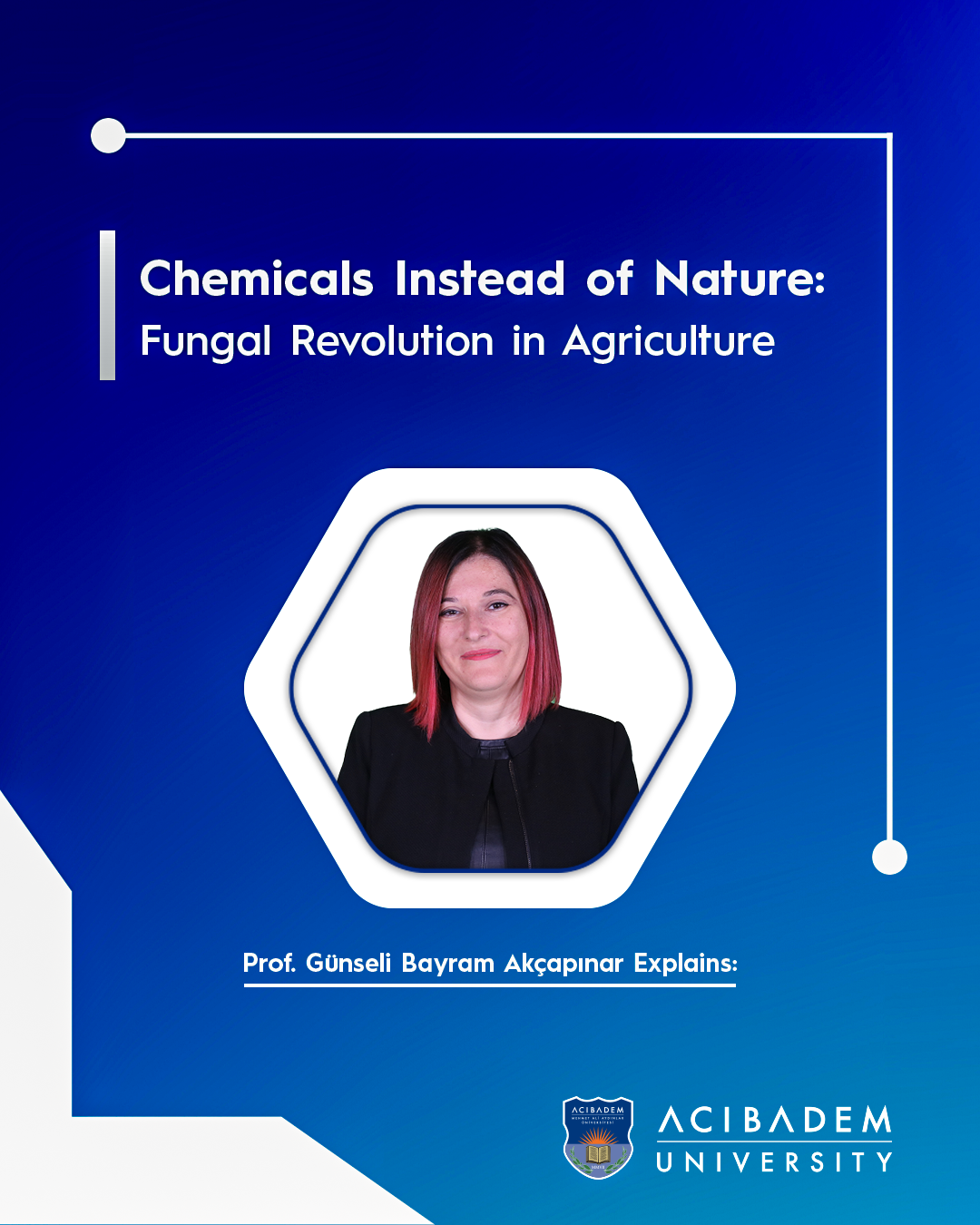
Chemicals Instead of Nature: Fungal Revolution in Agriculture
Agriculture requires more sustainable and environmentally responsible solutions than ever before in response to global challenges such as population growth and climate change. While chemical agents widely used in conventional agricultural practices may enhance short-term yields, they can cause long-term damage to soil health, water resources, ecosystems, and human health. For this reason, scientists are increasingly focused on developing alternative methods that are compatible with natural systems.
One such approach was examined in an international study in which Prof. Günseli Bayram Akçapınar, faculty member in the Department of Medical Biotechnology and Director of the Institute of Health Sciences at Acıbadem University, participated as a researcher. Marking the first scientific publication of a project supported by the Joint Genome Institute, the study was published in Nature Microbiology, one of the world's most prestigious scientific journals. The research reassesses, on a scientific basis, the use of fungi as an alternative to chemical inputs in agriculture.
This comprehensive study, which explores the future of agriculture through nature-compatible methods, sets out in detail the role of beneficial fungi known as Trichoderma in sustainable agriculture. Prof. Bayram Akçapınar states: “In this study, we examined how fungi that already exist in nature and contribute to soil health can be used more effectively in agriculture. Our aim is to protect plants through more natural means while preserving ecosystem balance.”
Noting that these beneficial fungi live in close association with plants and protect them against harmful microorganisms, Prof. Akçapınar adds: “These fungi both combat disease-causing agents and contribute to healthier plant growth, making it possible to achieve high yields with reduced chemical use.”
The Goal: Increasing Productivity Without Harming Nature
Emphasizing that the research extends beyond yield improvement alone, Prof. Akçapınar states: “Chemicals applied to the soil can, over time, cause harm to water, air, and, indirectly, human health. The approach we focus on aims to increase productivity without causing environmental damage, enabling both the protection of the environment and access to healthier food.”
Prof. Akçapınar further notes that the findings may pave the way for a more sustainable approach in agriculture: “We believe that nature-compatible methods will find an increasingly prominent place in agriculture in the future, and beneficial fungi such as these will constitute an important part of this transformation.”
The use of millions of tonnes of chemical pesticides worldwide each year poses a growing threat to soil, water resources, and ecosystems a situation that is increasingly recognized as a public health concern with direct implications for human wellbeing. Prof. Akçapınar underscores that biological control methods are gaining increasing importance in agriculture and that nature-based solutions offer more sustainable outcomes in the long term.
Biological Power in Place of Chemicals: The Trichoderma Fungus
Trichoderma is a genus of fungi widely found in nature, known for interacting with plant roots and supporting plant growth. However, only a small fraction of this broad family has been utilized in agriculture to date. Prof. Akçapınar notes that the diversity and functions of Trichoderma species have not yet been fully explored, underscoring the need for more comprehensive research.
Within the scope of the study, the knowledge gap concerning more than 500 species of Trichoderma was addressed at this scale for the first time. The international research team conducted one of the most comprehensive phenogenomic studies to date, analyzing 37 distinct Trichoderma species from genomic, ecological, and physiological perspectives. More than 140 traits were measured, and gene–phenotype relationships were mapped using machine learning methods.
How Do the Fungi Work?
According to the research findings, the origins of Trichoderma date back 66 to 100 million years, to the Late Cretaceous period. Prof. Akçapınar notes that this evolutionary process played a critical role in enabling the fungi to adapt to diverse environmental conditions. The study reveals that these fungi evolved not in soil, but on tree surfaces and in forest ecosystems, offering a significant new perspective on their application in agriculture.
One of the most notable findings of the research was the ability of Trichoderma species to suppress other fungi by targeting them directly. Prof. Akçapınar states that this characteristic represents a considerable advantage for biological control in agriculture. The species examined in the study were found to support plant growth by enhancing root development, biomass accumulation, and stress tolerance.
The research, however, contains not only promising results but also important cautionary findings. It was established that certain Trichoderma species can cause harm to plants and may, under specific conditions, pose risks to human health. In particular, certain species were found capable of causing infection in immunocompromised individuals. Prof. Akçapınar therefore emphasizes that microorganisms intended for agricultural use must be carefully selected and subjected to comprehensive biosafety assessments, stating: “Biological agents to be used in agriculture must be rigorously evaluated on a species-by-species basis.”
Agriculture in Harmony with Nature: Toward Reduced Chemical Use
The research demonstrates that sustainable agriculture is achievable not merely by moving away from chemicals, but by developing a holistic understanding of natural systems. Prof. Akçapınar underscores that, when used appropriately, microorganisms such as Trichoderma can help maintain both production efficiency and ecosystem health.
28 September 2026
Medical Biotechnology, Graduate School of Health Sciences
01 June 2026
Medical Biotechnology, Graduate School of Health Sciences
31 March 2026
Graduate School of Health Sciences, Medical Biotechnology